React & Modern Frontend (445 Qs)•Part 5: React Redux State Management (101 - 134)
What is flux?
Flux is an application architecture (not a framework or library) designed by Facebook to manage data flow in React applications. It was created as an alternative to the traditional MVC (Model-View-Controller) pattern, and it emphasizes a unidirectional data flow to make state changes more predictable and easier to debug.
Flux complements React by organizing the way data moves through your application, especially in large-scale or complex projects.
Core Concepts of Flux
Flux operates using four key components, each with a specific responsibility:
- Actions
- Plain JavaScript objects or functions that describe what happened (e.g., user interactions or API responses).
- Example:
{ type: 'ADD_TODO', payload: 'Buy milk' }
- Dispatcher
- A central hub that receives actions and dispatches them to the appropriate stores.
- There is only one dispatcher in a Flux application.
- Stores
- Hold the application state and business logic.
- Respond to actions from the dispatcher and update themselves accordingly.
- They emit change events that views can listen to.
- Views (React Components)
- Subscribe to stores and re-render when the data changes.
- They can also trigger new actions (e.g., on user input).
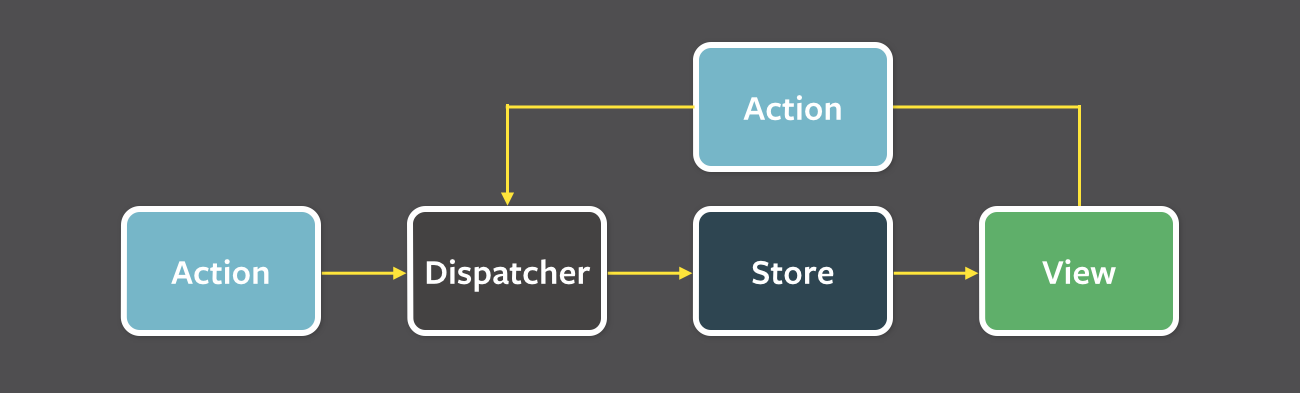
The workflow between dispatcher, stores and views components with distinct inputs and outputs as follows:
Practical Code Example
javascript
// Flux Architecture: Unidirectional Data Flow
// Action -> Dispatcher -> Store -> View -> Action
const Action = { type: 'INCREMENT_COUNT' };
AppDispatcher.dispatch(Action);